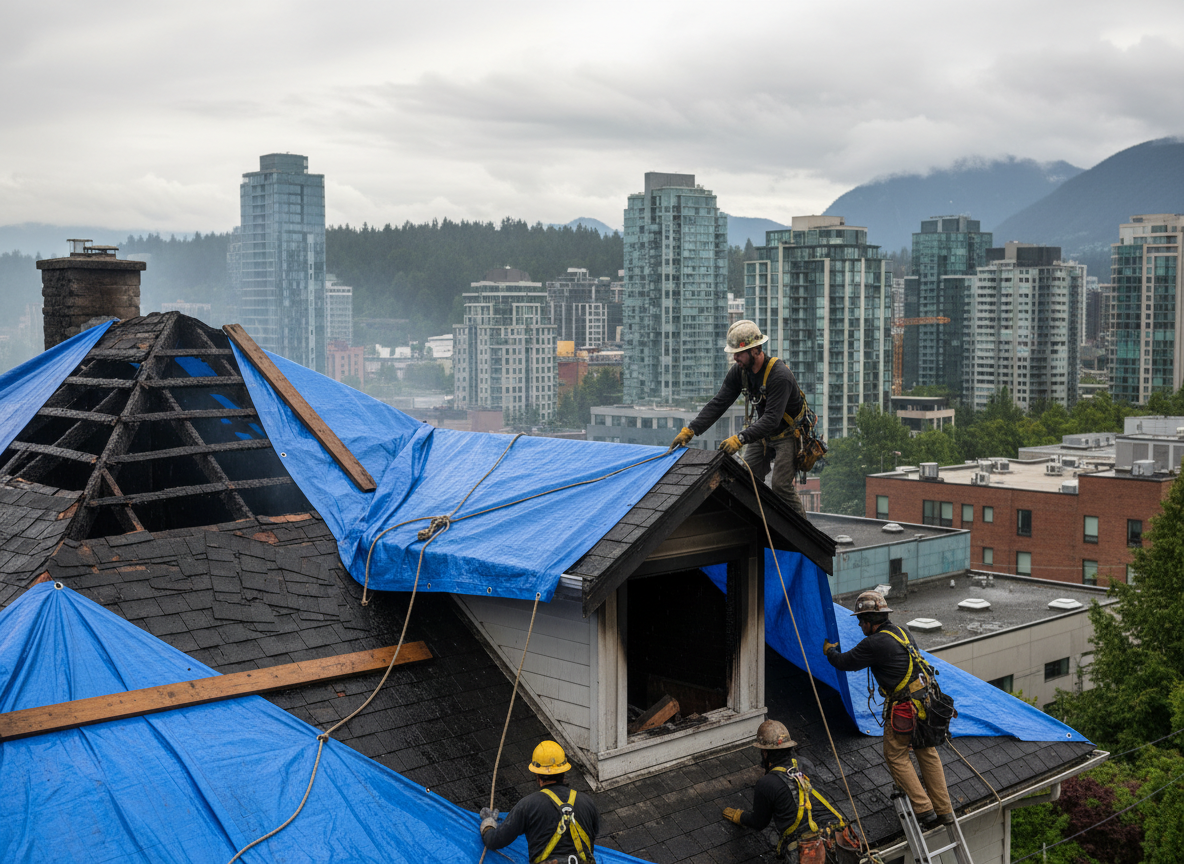
Fires in Clark County often strike during warm dry summers when vegetation and older wood structures in neighborhoods like Felida and Uptown Village ignite quickly. Once contained, the immediate priority shifts to tarping to block the mild wet winters that follow. Without prompt coverage, rainwater enters through compromised sheathing and travels along rafters into insulation and ceilings, especially in single-story ranch homes common around the Fort Vancouver National Historic Site. Local crews stage materials at 215 W 4th St so they can reach jobs in Hazel Dell or Orchards before the next front moves in from the coast.
Standard 10-mil reinforced polyethylene works for most asphalt roofs in the area, but steeper pitches near Waterfront Park and Pearson Air Museum require additional battens and perimeter sealing to resist wind-driven rain. Crews avoid driving fasteners into sound decking when possible and instead use weighted perimeter systems on tile or cedar roofs found in Camas and Washougal. Edge cases include partial burns where only one slope is affected; tarping must extend at least six feet past the damaged section to prevent water migration under the remaining shingles. Local building inspectors expect tarps to remain secure through spring winds, so crews add extra tie-downs on exposed ridges.
Older homes in Downtown Vancouver often have layered roofing that complicates fastener placement and increases the chance of hidden deck rot once water sits under the tarp. Crews always inspect for active smoldering before covering and leave ventilation gaps where smoke odor needs to escape. Homeowners in Orchards should never attempt their own tarping on two-story structures because ladder access on wet clay soil becomes unstable. Delaying professional tarping even a few days can turn a contained attic fire into full interior demolition once winter rains begin.
Technician insight
In Vancouver the thing that catches most people out with Roof Tarping After Fire is how quickly a dry summer burn turns into a winter leak problem on older homes in Felida. The clay soils stay saturated for weeks, so any gap in the tarp lets water pool against the foundation and travel back up into the structure.
Orchards Home After Attic Fire
Smoke and heat damaged one slope on a 1970s ranch in Orchards. We found the deck intact but the underlayment melted in two spots. We installed a full-slope tarp with extra battens along the ridge before the first November rain arrived. The homeowner avoided interior water damage until permanent roofing could be scheduled after the holidays.
Roof Tarping After Fire Services We Offer
✓Emergency Roof Tarping
Same-day deployment of reinforced tarps on fire-damaged roofs in Clark County to stop immediate water entry from approaching winter fronts.
✓Multi-Slope Tarping
Custom-fitted tarps that cover multiple roof planes on homes in Hazel Dell and Felida where fire damage crosses ridges or valleys.
✓Perimeter Sealing and Batten Securing
Installation of battens and sealed edges that keep tarps tight during the strong winds common along the Columbia River corridor near Washougal.
✓Temporary Ridge Vent Protection
Sealing or covering ridge vents after fire so smoke odor can still vent while blocking rain on homes in Uptown Village and Downtown Vancouver.
✓Post-Fire Roof Assessment for Tarping
On-site evaluation of burn-through depth and deck condition before tarping to avoid covering hidden hazards in older Orchards properties.
How it works
- 1
Site Safety Check
Technicians confirm the fire is fully out and inspect for structural instability before accessing the roof from 215 W 4th St staging.
- 2
Damage Mapping
Roof is measured and photographed to determine exact tarp dimensions needed for the affected slopes in the specific neighborhood.
- 3
Tarp Deployment
Reinforced material is positioned, overlapped, and secured with battens or weights chosen for local wind exposure.
- 4
Final Walk-Through
Homeowner receives photos and instructions on monitoring the tarp until permanent repairs begin after winter weather passes.
Pricing
Cost depends on roof size, number of slopes, and access difficulty. Upfront quotes provided after on-site assessment.